
Taking Word of Mouth Too Far
 10:18 AM
Edit Post
10:18 AM
Edit Post
 In case you missed it, there's a lot of talk about the embarrassing outage of Whole Foods CEO, John Mackey, covertly posting on web and investment blogs. Fellow contributor, David Reich opens the door for some good commentary on the subject here.
 As a Whole Foods fan, I'm just disappointed. As Ann Handley points out in her comments, you'd think a company that promotes the idea of "real" food would have executives that are equally "real." As experience evangelist, I promote the idea that great brands can stand on their own. Beyond the legal ramifications of this... I wonder if we'll begin now to uncover other trends like in companies we know and love?

STUCK or UNSTUCK?
12:00 PM
Edit Post
 My brain is full of posts. However, it seems the longest distance these days is between my head and the keyboard.
 For the past few months, I've been very heads down managing the strategy for a portal integration project for a B2B company in the high tech space. It's a complex company, with a complex audience and complex products.... and untangling that all to create something simple has been the challenge for our team.
So that's why I just haven't been able to extricate myself long enough to post, or read much. Amazing how easy it is to fall behind.
Last month, however, at the request of my friend Kelly Goto, I did take the time to pen one article she asked me for. The article is a personal story that runs parallel to Kelly's new gotoreport issue dedicated to the topic of becoming "UNSTUCK". The series primarily focuses on companies making the transition from Web 1.0 to 2.0.
Recently, Kelly and I played a good amount of "brain tennis" on the "STUCK" issue. As we chatted, we continue to marvel at how "STUCK" most companies -- or most individuals truly are. It happens to us, too. Whether we get mired in old legacy systems while moving to Web 2.0, or stuck in a culture that can't effectively innovate, implementing new models for customer-centric commerce.... or loosing ourselves to create a new, satisfying professional or personal lives...lots of us live stuck.
The article in this month's gotoreport is my personal story of becoming unstuck. Rather than post it here, I thought I'd link you over . While you're there, check out the other terrific articles on Web Usability, Design, and moving into a Web 2.0 development environment.
 Labels:

Flexible Customer Management Policies
11:15 AM
Edit Post
 Smart companies have customer service policies in place to protect their best interests and the bottom line. Smarter companies, however, know how and when to bend certain policies for customers who have the right profitability, loyalty, frequency of purchase and long-term revenue potential. This helps protect customer loyalty and works to maximize the bottom line.
The challenge in today's market, however, is institutionalizing a system wherein each employee understands customer centricity - and the right employees are adept in exercising flexibility with appropriate boundaries. Databases, systems and policies are critical tools. Executing based on the knowledge gathered by companies is another thing entirely.
Beyond loyalty programs, when it comes to appropriately recognizing customers in the service arena, most companies fall short. This is why customers losing out on good service have little choice but to become more vocal and tenacious.
Consider this recent experience.
I went to Best buy to accomplish two things: First, I needed to return an extra power source I'd purchased for my laptop. The associate who helped me had sold me the wrong model. The kicker was, I didn't realize it was the wrong adaptor for three months because while I had purchased the smaller model for a trip to Europe, I had forgotten to bring it with me. When I finally took it out of the package and realized the extra $90 power source was useless to me, it seemed worth trying to return.
Second, I was with my sister-in-law, Leah, who was ready to buy a new laptop with my assistance.
We trolled the computer department first, and I left Leah to play with the model I had recommended. I then approached the customer service desk to return the power source.
It only took a minute of watching the dull-eyed customer service representative handle the woman in front of me to predict that I was going to need a supervisor. After 10 minutes, she turned and walked away, cautioning me to get a supervisor if I wanted any “real help.”
When my turn came, I made my case and, as I suspected, “Dulleye” expertly spouted the 30 day return policy to me. I thanked him and asked for his supervisor. After a long wait, an eye-rolling supervisor approached, and the two huddled with briefly before he approached me.
It's enough to say that both "Dulleye" and "Eyeroller" expertly spouted "policy" to me. After explaining for the second time that 1) The packaging was intact; 2) The item had not been used, and 3) the exact model was still being sold on the shelves, I said in an exasperated tone "Look, YOU guys are the one who sold me this power source -and it's the wrong one!"
I was met by open mouthed, blank stares and a glance toward the counter from both of the policy drones. So, I continued:
"Does it help to know that I've purchased FOUR laptops at Best Buy this year alone? I've actually come to purchase another one today, and I'd hate to take that sale to another store because I'm short on time. What do we need to do to make this right?"
After another wait, I asked for the store manager. I watched as “Eye Roller” explained my situation to the store manager, shaking his head vehemently to indicate that Best Buy should not refund the money. So far, about 20 minutes had elapsed.
Hope sparked as the store manager walked over to me with eye contact and a hesitant smile. I repeated my plight to him. I explained that I would love to exchange the power supply for the right product, but they didn't happen to sell one. I was fine with store credit and it only made sense. He wasn't quite convinced.
So, with one final push, I drew upon my inside knowledge of Best Buy's customer management infrastructure and added:
"I understand you've got policies for a reason. In fact, I write, speak and teach about customer service for a living. Because of this, I also understand that Best Buy is flexible with its policies for good customers. I'm a good customer. In fact, it may help your decision to know that in Best Buy's profiling schema, I am considered a "JILL" and I carry a profitability level of four out of five. I understand this means that you guys should want to keep me as a customer at this store."
This is where the store manager got the nickname "Wide Eyes." I continued with a pleasant smile.
"Now, Jeff over there (pointing to our Geek Squad computer sales rep, Jeff as he waved) is helping me and my sister-in-law with my fifth laptop purchase of 2006. So, can we return this cable now, or do I need to head for another store?"
The store credit was issued immediately. We bought another laptop that day, too.
Now, I was fortunate enough to have been previously shown my entire Best Buy purchasing history, demographic profile and profitability number in an interview with a Best Buy executive several months before. She had explained to me congruently how someone with a profile like mine would (hypothetically) be handled in a return policy decision. The same executive had also described how hard it was to get her staff to understand the simple categorizations to make exceptions to the rules on a case-by-case basis.
I'm glad I had that knowledge in my back pocket – but ultimately all of this serves to make a point.
I’ve written a bit about Best Buy in the past. In short, what's great about Best Buy's system is that it maps customers to persona-based profiles that help associates understand the type of customer they are dealing with. It also assigns a simple profitability scoring scale from 1-5 (5 being the best). This should make it super easy for any associate to quickly grasp the value of a customer without doing a detailed analysis on purchase history.
… The problem is getting people to use this knowledge. I went through three people to get Best Buy to treat me like a "Jill" with a profitability multiple of four. And all three had access to my profile. Not one of them looked at that information – despite my earlier pleas.
The truth is, it just takes time to operationalize a flexible customer service framework. A myriad of factors weigh in, including training, turnover, management preferences, staff maturity, common sense, level of experience and individual store policies. Over time, it should only get easier for Best Buy to properly train customer service associates to review a customer's profile, understand their value and to take action that is fiscally responsible and that meets the customer's requirements to remain loyal.
However, until this happens, the sadder truth is, it's still the tenacious are more likely to get the service they deserve. While most of us aren't positioned to know how we're profiled in a store's database, there’s good news:
The visibility created by the internet, social networks and sites like "You Tube" are creating popular outlets for wronged and vocal customers. The exposure risk companies now face will only create more impetus for them to get customer service right the first time – and to invest in appropriately flexible customer service management policies and procedures.
When Scent Marketing Stinks: Four Points by Sheraton
1:38 PM
Edit Post
 I had an experience this week that serves as a great follow up to my previous article on scent marketing. Right now, I'm in San Francisco. I have been staying at the Four Points by Sheraton at the SFO Airport and commuting between downtown and San Jose.
Upon entering my hotel, I immediately noticed the scent of pie wafting from the lobby. In fact, the was pervasive in every corridor, inside my room, even outside the hotel and it didn't take long to suspect scent technology at work.
But first, I had to ask if they had pie at the restaurant. The waiter answered "only sometimes." Interested in how this related to the scent technology use, I inquired about the scent with the manager. He reluctantly admitted that Four Points is using scent technology to create a more home-like and welcoming atmosphere.
Oooh. Okay. Interesting. But here's what I noticed after four days...
Okay, so good for Sheraton for wanting to create a more "home like and welcoming" envorinment. The thing is, this goes to show that a comforting smell itself isn't without some drawbacks. Further, smell alone isn't going to create the home like experience.
There's no doubt, smell can be terrific for memory recall - and can be used to reinforce experience. But what heppens when the experience fundamentals are missing and smell reinforces bad experience? Let's talk about a few of the fundmamentals gone wrong at this hotel: Getting Settled.
How about a cold, clammy bath?
Comnecting by phone.
And what to eat?
The point is that customers don't like to go through hoops - we don't have them in our home environment, and we'd rather not have to jump through them at a hotel. In fact, hoops are actually contrary to creating a home-like and welcoming experience.
For the marketers that dreamed up this experience: Is the scent of Fresh Baked Pie is going to make me feel positive when so many other aspects of the hotel experience were simply annoying? Did the company do ANY experience testing whatsoever with real customers - travel weary people, families, etc.?
Either Four Points is trying to create a more home-like experience that drives brand affinity and loyalty, or it is not. From my experience at this hotel, it looks to me like they built a lot of marketing hype around a hotel experience that may fail to deliver. The question is whether or not what I experienced is a limited set up hiccups related to this hotel only.
Killing Customer Experience Gnats!
3:15 PM
Edit Post
 My husband and I joined the Vonage family last month and I have to say, it’s been good for the most part. The price is good - even for international calling. The service seems to function reliably, although we’ve had to restart our modem a number of times to get things working again after cut-offs - even a few mid-call, which has been inconvenient (buzzz). However, I’m not sure if that’s a result of my ISP or the Vonage service, itself.
 But that’s what this post is about, really...it's about gnats. Bear with me as I buzz through this, a second...
As I tried to figure out the USER ID and password my husband set up today, I noticed a cute little application running on the site. It was an interactive flash app, which called out various service components with value-based messaging. Each service topic linked to an animated tutorial with a voiceover that would expand on each topic. At first, it seemed well produced and looked like this:

"Cool," I thought, "Let me learn more." The problem was, however, when you clicked on all but one of the four topics, the description that came up didn’t match with the topic name. For example, the “Voicemail” topic linked to information about toll free numbers. “Toll Free Plus” linked to information about voicemail. “Soft Phone” linked to Caller ID… It was confusing and I still don’t know what Soft Phone is... (buzzz)
So, like a good little usability expert, I decided to call Vonage to report the problem. As I tried to find a phone number, I noted an option for what I perceived to be web-based support. The graphic said “Need help now? Ask Vonage.....our interactive, personal agent” After typing my question, I got this:

For those of you who do not have x-ray vision and cannot read the text by the green arrow, it says "I am a robot" in response to my question "You aren't really a person, are you?".
So, this wasn’t a chat-based application featuring a real agent or person. It was instead, just a hyped up marketing driven way of presenting FAQs by presenting them in a pop-up window and calling it an agent. Not a huge deal - just another hurdle to go through on my quest for satisfaction and a minor irritation... (BUZZ)
It’s significant to mention, however, that these two little issues – and they were little - added to some “back of mind” irritation I already felt after some other experience irritations. You see, in my experience over the last few months, both my husband and I had encountered more than a few usability hurdles on the company’s corporate and password-protected customer web sites…(BUZZ) For example, it is surprisingly unclear how to set up your voicemail message, and mine is still embarrassingly absent. (BUZZZZZZZZZ!)
Why the Buzz? To make a point. Little usability problems are like pesky “experience gnats” that bother consumer increasingly over time. Sooner or later, the irritation they present may force people somewhere else… and that’s where the risk is for most companies today.
This is especially true for a company like Vonage, which has first-mover status in this category, along with a relatively high hurdle to conversion and a seemingly complicated set of service options. This is also especially true for companies in rapid growth modes, which are rapidly developing and launching new products and services to new markets... adjusting messaging and service offerings to maximize conversions along the way.
Simply put, clarity and ease of use are critical.
Where Vonage has succeeded on many fronts to create an understandable product and achieve market penetration – the risk they face (like many of us) is that someone else will come along, learning at their expense to create something that’s even easier to use. We’ve seen this happen in the market thousands of times.
That’s why Vonage – and companies like it – can’t afford to skimp on customer testing!
Ironically, some simple user acceptance testing would have registered the glitch in the little service app I noted. Customer testing may have also identified the perceptional challenges that are created by applying a marketing term like “AGENT” to what equates to a FAQ engine… It may also have uncovered the myriad of simple usability challenges I noted on Vonage's customer targeted web site – as well as the support collateral they sent us when we became new users.
Killing the experience gnats is best supported by effective iterative product development lifecycle management.
Using the right iterative model, appropriate levels of testing can be “built in” at various stages of work to ensure the end-solution meets the needs of the business, audience and answers market need.
Employing appropriate testing approaches across the development lifecycle will help identify areas of the environment may cultivate experience gnats - and elliminate them.
Ineffective iterative approaches applies testing at a level that is too shallow or narrow. Testing that fails to go deep enough may fail to uncover functional problems that impact a large number of users. Testing that is limited within a single channel can create experience pitfalls - because each time changes are made, they can have a cascading effect on other areas, including collateral, web experience, site content, service policies and other key experience areas.
Poorly executed planning can happen for a number of reasons, including ignorance or poor governance. However it is often present because of (or at least impacted by) insufficient development timelines, development delays, or "executive pushing" due to business pressure. This drives increased pressure for launch and often subverts customer-based testing (e.g. usability testing).
Good iterative processes support testing that assesses individual components as well as the overall, cross-channel experience, to ensure the user’s journey comprehensive experience is as clean, "gnat-free" and seamless as possible. This testing is never done - it continues as the products and services evolve over time. It requires time, investment and dedication - and very importantly, executive support.
Beyond the gnats, iterative testing may help identify serious customer experience pitfalls.
For example, perhaps this kind of testing would have uncovered the "irritation factor" caused by Vonage's hidden "15-days-from-purchase" clause on the modem rebate! We didn't install Vonage for 30 days and "ate" the cost of our $60 modem as a result. This wasn't an experience "gnat" it was more like a horsefly - one that has undoubtedly motivated other users to return the product (I know of one) and increased Vonage's barrier to entry. :-P
Incidentally, I did get touch with Vonage by phone and reported the little application error, which hopefully by now, they’ve fixed. The associate was affable, responsive and thankful for the report. She was also helpful in resolving my own issue. Her approach and demeanor squashed a few gnats for me and left me feeling generally positive.
Ultimately, experience gnats like the ones pointed about above can be encountered with almost any company - so the goal here is not to be nit-picky. Some gnats are bigger than others, as we've pointed out - including self-service usability problems and hidden clauses that screw the customer. Testing can help ensure that, as we architect experiences, we avoid "leaving out rotten apples" that can attract and colonize gnats, and annoy customers. Using the right development methodology, which leverages practical testing to anticipate and correct address potential experience pitfalls that can have a cumulative effect of undermining customer relationships.
Scent Branding: Smell of Success?
4:25 AM
Edit Post
 Yesterday at the gym, I was pedaling away on the Arc Trainer when a cute 80 year old lady came up and sat down on the recumbent bike next to me. She seemed innocent enough, until she turned out be an environmental affront! As I involuntarily placed my towel over my nose and mouth, I realized she had coated her coiff with an overt amount of noxious hairspray. As her cheap perfume combined with the hairspray fumes, it rose to assault my nose (and tastebuds!) and cause my lungs to constrict.
Now, this little old lady held herself with pride. She liked her hairdo and she liked her perfume: It occurred to me that this was a part of her little old lady brand! I dare say, she probably used those very things to snag herself a little old man somewhere along the way…
But for the gasping sweat hogs in the gym... the little old lady brand scent wasn’t a good thing. I actually moved to another machine – next to a man – who unfortunately smelled like curry (but we won’t go there). Not a good gym day.
Lest I digress, I found this all ironic, because I had just started a piece on Scent Branding..
Scent Branding is a discipline of sensory or experiential marketing. It has been promoted by Gerald Zaltman and many others including the Scent Marketing Institute and has become a 14 billion dollar global market for retailers and marketers looking to enhance brand experience.
Some may think "scent marketing" and identify with a company like Yankee Candle . Yankee understands the power of scent – but today’s technology goes beyond melted wax, potpourri and fragranced oils. Consumers can now purchase small scent dispensing machines from the grocery store. Check out Febreeze's Scent Stories Machine uses fragrance discs to disperse scents like "Mountain Trail" and "Tropical Island" in the home. But most significantly, scent technology today reaches far beyond the home.
While you may not realize it, you have probably been exposed to scent technology sometime within the last 60 days. Scent branding is being broadly deployed in major retail, boutique stores, airlines, museums and marketing venues across the globe, and in a neighborhood near you. This is not a new field and the science of smell has been leveraged in product development for years.
So why all the commotion (see articles in Forbes, USA Today, Washington Times, Ad Age,) over Scent Marketing now? It's simple: The sense of smell is one of the strongest and most powerful triggers of emotional memory.
With rapid recall, each one of us can conjure up the smell of Christmas, a newborn baby, fresh cut grass – or the smell of “home.” The mere recall of a fragrance can to mind a myriad of associative memories, as well. And fragrance makes a lingering impression: Published studies suggest that people recall smell with up to 64% accuracy after one year. Now, that’s powerful associative power!
Used in the right way, scent branding can enhance customer (or personal) experience in a pleasurable manner. The use of scent branding in consumer purchasing environments has been shown to be influential in driving consumer purchasing, as well.
Scent Air, a market-leading scent technologist has used scent technology effectively in a myriad of environments since the year 2000. The company today maintains an impressive client list, including major retailers, upscale hotel chains, airlines, retail chains, boutiques, museums – even beer companies.
Want an example of Scent Air at work? Walk in to a new Sony Style retail store and you may catch a whiff of the custom Sony fragrance engineered to compliment the store experience. It's a combination of mandarin orange, vanilla and cedar. In addition, you may experience Scent Air's ScentWave technology at work in Bloomingdale, where customers detect the distinct smell of baby powder in the store’s baby department, or a hint of suntan lotion in the swimsuit area. The company recently deployed ScentWave technology to project "waffle cone" smell adjacent to a to find ice cream parlor in the Hard Rock Hotel in Orlando, which was instrumental in driving a 50% sales increase.
Beyond large-scale retail deployment, the company also has systems that support 15 foot scent projection for POP deployment, as well. The firm ran chocolate scent tests at a vending machine in Santa Barbara which drove chocolate sales up 60% (with overall sales up 15%). Think about this next time you go grab a candy bar. The same chocolate scent was used to “flavor” the premiere of the film “Charlie and the Chocolate Factory” last year.
So there’s power in scent branding - but is it ALWAYS good?
Even for this aromatherapy fan, the acrid scent of Aqua Net and Jean Nate serve to remind me scent marketing can go bad for a variety of reasons.
For example, even though I like fragrance:
I often resent Cinnabon for projecting the haunting cinnamon bun smell, which beckons me to depart from my diet at the airport or in the mall food court. I want to karate chop the "perfume nazis" at major department stores who assault me with “complimentary spritzes” of the latest fragrance. My head reels in Sephora, where overpowering smells distract or disorient me – even giving me headaches that prompt my departure.
…And I’m not the only one that can get irritated: Consider this scent branding case study gone wrong (hat tip: Ad Age):
Cookies. Yum! Most of us like the smell of fresh baked cookies, right? That’s what the Milk Board thought, when they launched “Got Milk” ads, in five bus shelters in San Francisco. The Ads were accompanied by strategically placed “scent strips” that smelled like home baked cookie heaven. The thought was that perhaps the association would motivate individuals to enjoy a glass of milk with their next cookie.
Now this would seem like a public service to some of us. I know for me the smell of cookies beats the smell of garbage, car exhaust, or as Ad Age puts it - urine or vomit (which is often what bus shelters smell like). Evidently this was not the case!
Although it was a small scale deployment, the cookie scented ads spawned aggressive protest from groups representing individuals with environmental allergies, asthma, chemical sensitivities, diabetes, obesity and even those who represented the homeless (shame on the Milk Board for making them hungry).
Ridiculous? Perhaps.
While the news isn’t likely to thwart the growth of this multi-billion dollar industry - or the Milk Board's future use of scent branding, it serves to remind all of us that the power to use scents to enhance customer experience is both a gift and a responsibility.
As we recall my little old lady example here are some things to consider when leveraging scent branding in the experiential environment:
Something to think about as we add common sense to our choice to add scents to drive cents and drive brand affinity through enhanced customer experience.We can’t depend on smell alone to create the brand association. Scent branding uses smell to attach a user to an experience with an environment or event. Therefore, the environment’s layout, design, structure, customer service, products, music, lighting, flow are extremely important. Things that smell “good” to some may not be good for all. As anyone in product development will tell you, testing is required to ensure that scent marketing is helping, rather than hurting with the target demographic. Adjusting the scent “volume” is essential. Overpowering customers with smells that seem overwhelming may be a real turn off. Some venues call for overt scenting (e.g. Cookie store) but most (hotel room, boutique) require a more subtle approach. The use of too many fragrances can be a turn off. Just try smelling different perfumes for 15 minutes and you’ll catch the drift. Combinations should be tested and adjusted carefully. Scent context is important.The smell of men’s cologne spilling into the women’s dress department may be confusing. The smell of a Christmas holiday in say, a galvanized, sterile environment may be confusing. The power to smell and respond to odors differs based on age group. For example, The Boston Globe reported that kids are up to 350 percent more responsive to the five senses than adults, and especially to smell. The elderly population will not be as keen or carry the ability to notice certain smells. Individuals may take offense at highly obvious scent dispersion.. My example of Cinnabon stands – people tend to resist and resent overt manipulation. Successful scents can carry over into other areas of brand extension. Popular fragrances can be sold to eager consumers for home use, used in room sprays and other scented merchandise (candles, potpourri, sachets). Perhaps most important: the chemicals used in of scent dispersion systems can create problems for people with health or medical problems. These include chemical sensitivities, allergies or athsma. I'm not aware of any lawsuits right now, but be stay tuned.
Experience Addressable Advertising
4:54 AM
Edit Post
 Here on the Experience Architect Weblog, we talk a lot about the cross-channel Customer Experience but we also like to highlight innovation that is occurring within specific channels as well.
 Here's a company that is working within the "addressable advertising" space - not just to change the way television advertising works - but to revolutionize the creation and assembly of addressable ads. This has ramifications now, as well as for the web and mobile channels, as well.
Enter Visible World, a company that has successfully pioneered advertising technology to enables the on-the-fly assembly of highly targeted television advertisements to any single broadcast or cable network and any broadband internet destination.
As Tara Walbert, VP and GM of Visible World explained it to Cable 360 last month, it's easiest to think of Visible World's technology as "mail merge for television".
Visible World’s technology streams a set of commercial elements (pieces of a commercial - video, text, audio, etc.) down a dedicated feeder channel from its own production/post production toolsets. The Visible World package then interacts with household data contained within the set top box, including information regarding geography, household behavior, interests and channel/programming preferences. Using this information, the technology applies pre-established variables (essentially business rules) set up within the post-production tools to assemble and deliver the most appropriate ad in real-time.
Visible World offers a suite of tools to enable "Intellispots." The tools include a specialized Ad Server called the "Ad Jukebox," which is used by media companies to serve addressable ads. The company also provides dashboards and production tools, which enable agencies and creative resources to envision, create, control and measure addressable advertisements through participating networks.
Visible World's production tools can also utilize data from other sources (e.g. Prizm data, geographical data - even databases like AccuWeather or client database information to enhance the conditional logic for ad messaging.
It doesn't take much imagination to see how this might be used by the creative advertiser, as Jonah Bloom at Ad Age pointed out this week.
In the arena of addressable advertising there is a host of vendors innovating and competing in the space, including OpenTV, Navic, Invidi and others). In the fray, Visible World has been at this awhile – and their campaign management tools are something to consider for the experience architect of the future. The company promises also to enhance its tools to meet emerging needs within online and mobile channels as well (IPTV).
My readers can demo the technology yourself through a simple web interface here. Just enter USER ID = leigh and PASSWORD = path (all lower case).
I emailed the company to obtain more information about metrics, privacy and integration with traditional advertising infrastructures, but did not hear back in time for this posting.
Follow Up: Power of Persona
2:08 AM
Edit Post
 Bit of a follow up here. In our last Experience Toolkit we talked about "The Power of Persona." That is, how using personas can foster a more tangible understanding of a target audience's needs, desires, pet peeves and behavior. Personas create "real life" scenarios that support customer dialog inside an organization, and rally teams to drive multi-channel development in a manner that results in a more cohesive customer experience. The Marketing Profs syndicated article got some good feedback, and I received a number of questions including those surrounding the application and creation of personas in the market today.
 So here's a follow up with a few comments.
There are tons of great articles about he use of persona out on the web, and I highly recommend a search and read on the topic. One article you might want to check out is a presentation from Forrester Research on Personas as a Best Practice (slide show). There's also a great article from Advertising Age in June 2006 (PDF format) for your reference.
It's impossible to deny the emerging significance of personas in defining, designing and refining customer experience, product and interaction design. While many have embraced the value of persona use in interaction design (software/web), many organizations are now thinking bigger. It's about time.
We've already talked about Best Buy, which employs a deep use of personas in customer profiling, databases, store design. I'd love to see are some updates about the evolution of Best Buy profiling. On an inside track, I've learned that Jill is no longer the woman described in the Washington Post article mentioned above - she has morphed, and they've got new female profiles now. Whatever the case, it's obvious Best Buy is learning a lot at a time when competitors like Circuit City face some harsh business reality. Best Buy has invested in evolving its business model and they're reaping benefits in the form of growth.
Anecdotally, Best Buy's employees are also learning a lot about recognizing customers and realizing market opportunity, as well. One 20-something music department employee from a Best Buy store in Texas called his manager's attention to a key demographic being missed entirely in the store: the Mega Church attendee. Under the manager's direction, the employee conducted research and created a listing of Christian Music that he felt would boost music sales in the department. The manager took the recommendations to corporate HQ and gained permission to test the idea in the store. Within months, music sales increased in the music department by 15%. The program rolled out to other stores across the region shortly thereafter.
On a different note, I've followed some work that Organic has done with Chrysler this year. Working with a stage design firm, Organic developed "persona rooms" designed to inspire more customer-focused development of cars (and marketing programs) to Gen X customer base. The persona rooms allow Chrysler designers to work within the customer's personal space and absorb the interests, needs, desires and personality to inspire design direction. The rooms feature personal style, taste, products and musical taste and even go so far as to feature bulletin board updates and "My Space" pages for several of the personas they have developed. (You can read more about this in the article from Advertising Age June 2006 article (PDF format).
Looking at other applications for persona... I have a client who has used personas for the development of integrated campaigns and programs for several years. She is now looking at how to use personas to change the way she manages and structures teams inside her organization. As an executive marketer, she serves a diverse audience of technologists, product developers and other characters. She uses personas to help her staff understand the needs and drivers of these individuals to empower them to manage their "internal customers" more effectively. She also counsels her team on how to rally participants around shared goals that center on customer need and experience. In her words "it's a pain, and it takes more time. I'm still working out kinks all the time, but I gotta tell you, when you get the right team balance, the right customer focus and the the right programs to connect, the results are magic. We've only seen a hint at how this is going to pay off... and my staff recognizes the power of working this way, too."
There's no end to the companies that are using personas to develop multi-channel experiences. Consider Starbucks, is using personas to develop annual reports (among other things). Discover Card, which used personas to create marketing campaigns to various types of customers. Roche Pharmaceuticals, which used personas to create multi-channel campaigns targeted to women with osteoporosis, and Ann Taylor, which is using personas to focus targeting and retail design.
Ultimately, it's not enough just to develop a persona, or group of personas. That's the end, not the means. The goal of persona use is to develop a well defined, and easily articulated picture of the cusstomers we serve. We must iteratively use personas to benchmark and refine our view of the customer as much as we use them to refine and shape the architecture that supports customer experience. The lesson of it all: when we shape our organizations around a well defined knowledge of who we serve, we in turn empower our organizations to serve those customers well.
D'Oh - Old Navy Experience Hiccup
11:40 AM
Edit Post
 We've talked a lot about the fundamentals of customer experience on this site. We've also talked about how operational issues cause customer experience compromise. Unfortunately, as most of us know, it's easy to miss the boat on these fronts.
 While I'm sure there's more to the story, I thought I'd share this potentially great example of these dynamics at play. I got this rather compelling email from Old Navy today:
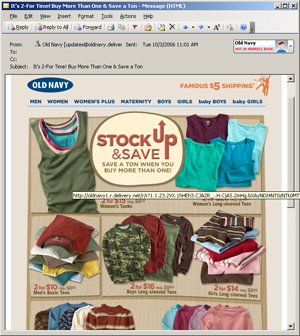
About 10 minutes later, I decided to surf to Old Navy and save. I opened up the email and clicked - and got a 404 error. I then clicked five places of the email and got a "Server not responding" error. I checked my internet connection and clicked once more, where I got this page:
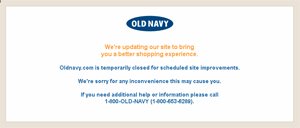
The message reads "We're updating our site to bring you a better shopping experience. Old Navy is temporarily closed for scheduled site maintenance..."
Planned site maintenance? In tandem with the release a large push email?
I'm sure there's more to the story than this, but it sounds like one of two things happened: Either 1) The development and marketing departmental silos aren't communicating well together in an effort to coordinate outbound marketing with planned site maintenance... or 2) perhaps Old Navy's site went down due to an overwhelming response to the email.
In the latter case, it appears Old Navy only has one error screen to use when the site goes down. It basically says "We're closed, and we planned this." That's a pretty rude message for a customer who was JUST invited shopping! If the site did go down (and hey - it happens) wouldn't it be better for Old Navy to have an alternative error message for non-planned outages that says something this:
"We're sorry - the site is temporarily unavailable. To compensate for your inconvenience, we'll give you an additional 10% off your next order. Just use this code when you check out: 123ERROR. Print this now and check back with us later to save even more! Thanks and apologies from your friends at Old Navy."
Better to recover those shoppers at a cost than have them forget to come back, right? Not so hard to do, either.
Based on my estimation, the site was down for about 2 hours ... It's back up now. I can't help but wonder how much this little snaffu cost Old Navy today?
Getting the fundamentals of experience right can't be overstated. It requires cross-departmental communication, coordination and scenario planning. When this doesn't happen, it wastes corporate energy, burns revenue and has the potential to seriously damage customer relationships. Of course, I'll go back to Old Navy... this is just a good "food for thought" example.
Experience Toolkit: The Power of Persona
9:39 PM
Edit Post
 Imagine with me for a minute that you're on a charge to make your company, or your product, or your web site increasingly customer centric. So you have a company-wide kickoff to rally passion around the customer.
"We need to better serve our customer and be more customer centered," says Joe the CEO. "To do this we're going to..."
…and Joe then rattles off a list of initiatives like retooling the customer database, increasing call center resolution by 6%, reducing churn by 20% and redesigning the self-service web site.
I can't tell you how many of these meetings I've been in. While they’re often informative, they fall flat in rallying the troops because in the end, they're about tasks, not about the customer. They fail to unite individuals around real people and a common set of goals that will help service those people, and instead focus individuals on operational activity.
To rally an organization around the customer, it’s a good idea to make some introductions. In an increasingly complex world of demographic, psychographic and ethnographic research, it’s no longer safe to assume that your employees actually know your customers. When rallying the troops, getting back to basics and keeping it simple can be powerful. One of the best ways to do this is to harness the power of persona.
My friend, Kelly Goto has been preaching the power of persona for more than a decade, specifically highlighting power of their use pertaining to web design. Kelly and I frequently work together, and for years we've been harnessing customer personas to develop a clear picture of the type of audience we're designing for. They work for web sites, products, brick and mortar store experiences, marketing campaigns … you name it. The results are great – and they’re effective in uniting diverse work teams around a set of customer-centric objectives. All tasks and activities are then tooled around customer goals.
So what's a persona?
A persona is essentially a representative profile, which summarizes a key demographic target. It is usually accompanied by a photograph of a representative customer who is given a "real name" and assigned some basic demographic data (such as age, marital status, tangible occupation and income) as well as relevant information pertaining to personal behavior. Personas represent the "real face" of a customer and make it easier to unite groups of people around the customer base. There are usually a number of customer personas for any given project.
The use of personas, along with the method of validating our designs with real customers in an iterative manner across the design lifecycle is a powerful way to unite and rally staff members around customers and guide activities (design, production, laungh) effectively. .
Taking personas a next step we also recommend the development of "customer scenarios." These describe, in further detail, the needs, behaviors, preferences and requirements that will fuel the development of customer experience. Customer scenarios essentially describe the optimal experience the customer should have, and can be used to drive the development process - and as a reality check during testing. They're highly effective for uniting the diverse teams charged with developing customer experience. Here's an abbreviated sample from Kelly's best-selling book, "Web Re-Design: Workflow that Works.":

Email snaffu
9:50 AM
Edit Post
Hmmm, blogger's image attachment isn't working this morning, for some reason. This is my first image-free post.
My cup runneth over: I've had so many rich experiences lately I'm bursting with ideas and things to write about ... yet still no time to write.
Three days after returning from my honeymoon in Tahiti, I got a contract on my house ... This was a real blessing after the market changed from a seller's market to a buyer's market here in the DC area. Now, after just one week, the new owners are already chomping at the bit to close.
SO! while I'm still reeling from my beautiful wedding and 15 days of honeymoooning, I find myself neck deep in boxes! But that's not why I'm writing this.
Wouldn't you know it: Smack dab in the middle of our over-the-water bungalow bliss, I discovered that my email server went down on Live Path. Ironic that this is probably the first time in a decade that I haven't checked email every day. While it's back up and running now, it was unfortunately, out of commission for several days.
So, for all of you who tried to contact me: I'm missing some email. If you got bounceback, feel free to try again - and please accept my apologies!
Back to my packing and my short work hiatus. In the words of Arnold Schwarzenneger, "I'll be back."
My cup runneth over: I've had so many rich experiences lately I'm bursting with ideas and things to write about ... yet still no time to write.
Three days after returning from my honeymoon in Tahiti, I got a contract on my house ... This was a real blessing after the market changed from a seller's market to a buyer's market here in the DC area. Now, after just one week, the new owners are already chomping at the bit to close.
SO! while I'm still reeling from my beautiful wedding and 15 days of honeymoooning, I find myself neck deep in boxes! But that's not why I'm writing this.
Wouldn't you know it: Smack dab in the middle of our over-the-water bungalow bliss, I discovered that my email server went down on Live Path. Ironic that this is probably the first time in a decade that I haven't checked email every day. While it's back up and running now, it was unfortunately, out of commission for several days.
So, for all of you who tried to contact me: I'm missing some email. If you got bounceback, feel free to try again - and please accept my apologies!
Back to my packing and my short work hiatus. In the words of Arnold Schwarzenneger, "I'll be back."
Work in Progress
12:24 PM
Edit Post
 To my very patient readers,
No, I have not fallen off the planet. I am eight days away from my wedding, and engaged in a last-minute client project! I find myself torn, somewhat, as my head is just FULL of stuff to write about, but there's been no time! To spare my poor fiancee the pain of last-minute blogging on our honeymoon, here's a preview of what's ahead...
I'm working on an article coming on the Power of Persona, which explores how making customers more "real" to your employee base and drive better customer centricity, learning and behavior. In addition, I'm cranking out some articles on Customer Experience Mapping - meaty stuff - from worksessions to recommended tools, etc. Finally, I'm working on another Experience File on a chain of brew pubs on the West Coast. That sure was fun research. HIC!
On another front, we're also developing a CEM webinar series. The series will be offered in a large group format, and can also be customized for dedicated corporate sessions, complimented by QA and light consulting. While this is still taking shape, the series will dissect aspects of CEM as follows:
If you're interested in engaging in these series, please feel free to drop me a line. I'd love to hear from you . Be sure to mention any specific needs or interests.
Okay. Better go get married now. See you in a few weeks! Stay customer centered!
Delta Airlines...in Diapers?!
2:30 PM
Edit Post
 My buddy, Karl Long picked this up before me, because I didn't check into Ze Frank's vlog yesterday. Evidently, Delta airlines has upset poor Ze...and he's letting the world know in the way only he can.... with adult diapers, hysterical insults and poignant commentary.
How many times have you wanted to do something like this out of sheer frustration with a company!? Well, now you can.
Yet another lesson in managing customers effectively and the impact of social networking. Vive el ze!
the show with zefrank
Enjoy!
Good readin': The Lifespan of the CMO
12:30 PM
Edit Post
 Great article this morning in Advertising Age on the average lifespan of a Chief Marketing Officer. The article cites a study by Spencer Stuart, which says that the lifespan of the average CMO shrunk slightly from 23.6 to 23.2 months this year.
 The story cites some interesting reasons for the "alarmingly short" CMO lifespan, including pressure to perform, being hindered by the CEO, short-term demands of Wall Street and executive "poaching." This may validate things many of us intuitively know.
I had some thoughts as I perused this article... First, I couldn't help but carefully consider this quote from Jeff Bell, VP Global Marketing at Microsoft's Interactive Entertainment Business:
"The shorter tenure is in part a reflection of the change from failing traditional-marketing approaches to less-defined and more dynamic approaches...Clearly the skill set of CMOs is changing from 'TV, TV and more TV' to interactive media. ... As the world of marketing completes this transition, the tenure will stabilize."
Couple thoughts...
First, what is "less defined and more dynamic?" In the new marketing paradigm, if marketing is more dynamic, then shouldn't it then be even MORE defined - so that the organization can be proactively prepared to meet the customer's need with agility?
Next, I respectfully assert that it's important to realize is that it's not just about interactive media these days. I agree that executives who don't understand how to leverage the principles of interactive media will be left behind. However, marketers who think only with a new media mindset may very well miss out on the critical need to create synchronized experiences across online and offline channels that build brand cohesion and customer affinity. Further, they may neglect the very large portion of our consumer audience that is aging or elderly. These populations grew up on traditional media....and they've got a lot of buying power. So it's really about conversion and experience, in the end.
Finally, the job tenure may well stabilize over time. However, we can't forget that there's a lot of experimentation going on in traditional and emerging channels such as wireless. There will be a lot of trial and error - and with the error will come shakeout. So the stabilization may take a longer period of time than we may like to see. This may well be compounded by more than the short-term demands of Wall Street as well as the short-term mentality exhibited by many executives today.
The article cites the fact that most executives (53%) have been in their job less than one year. Only 25% will make it to the three year mark. The article references the "revolving door" syndrome, as a major brand threat today. I've witnessed this in client environments, where much of the continuity within the marketing department is driven by the third-party advertising agencies that have provided ongoing support. It's a sad thing when your agency knows more about your history than you do...
So what does it take to be a CMO superstar? Pointing to icons like Starbuck's Anne Saunders and Burger King's Russ Klein, Greg Welch, CMO and practice leader for Spencer Stuart asserts:
"We believe the new super CMO and examples on this list were true general managers before they took the CMO role," said Mr. Welch. "The complexity of this job, the ability to be board-savvy and work cross-functionally effectively are the attributes of new CMO," he said. "That may be the new model of CMO that can make it last and make it work."
There's more to read, just a few highlights. Feel free to peruse the article yourself!
Experience File: Kayak.com
11:50 PM
Edit Post
 With all my business, wedding and family-visiting travel, I have been spending an inordinate amount of time searching for airline tickets lately. Even with modern search tools, the process can be laborious -- especially when coordinating people from different areas of the country. That's why, when I discovered Kayak.com, I decided to spread the word. My sentiments, in summary, are "hot dang, and hallelujia!"
 Kayak.com is a great study, which illustrates the real power of customer centricity in usability. My hope is that a tour of the site will remind all of you well intentioned business and marketing executives how important it is to "press the envelope" on usability in a proactive manner. It’s important to pay ongoing attention to user tasks and intentions to structure intuitive, usable and ergonomic tools that drive usage - and profitability.
The online travel booking arena has come a long way. However, it’s still rather easy to become dissatisfied with the search tools offered popular travel sites. While Orbitz.com, Travelocity and others offer rather robust search capabilities, they often place the impetus on users to do acrobatics to find what they really want. For instance, users must often start over, in order to "tweak" search listings to better "fit" with individual need. This often wastes time and energy, and can also produce frustration.
For example, say that I've posted a search on Orbitz.com. After doing so, I desire to "tweak" that search to filter for specific departure times. I’m forced to either scroll to view specific times, or start my search over to enter my departure criteria. This is cumbersome. From a task-based perspective it’s fairly common for a user not to be "ready" to "tweak" a search before viewing an initial “blanket” result. This challenge applies to a number of scenarios. For example, if I want to compare prices or flight times across the three airports out of which I often travel, I may have to conduct multiple searches.
While some of the sites offer helpful comparison grids illustrating fares out of several airports, or "fare alerts" that show lower fares into different airports, these aren't helpful, if you're comparing multiple search dimensions, such as price, departure time and airport. If I want to filter out certain airlines from my search, most of the time I will be forced to manually scroll (and scroll, and scroll) to obtain the information! If, in the context of these acrobatics, fare information is presented to me on several screens, the impetus is placed on me to remember the fares. This becomes more confusing as I age…
There's a reason that Kayak.com, was voted Travel & Leisure Magazine's top Travel Site in the category of "Search Aids". Boy, do they deserve it! The site is an ergonomic, robust, responsive mega search engine that is made for people like me and people like you.
Like the other travel sites, Kayak searches thousands airlines for low fares. However, it also searches low fares across travel sites, including CheapTickets.com, Orbitz, Travelocity, HotWire and others. That's rather convenient for those of us who have noted fare differences between those sites.
Beyond the scope of search, the real gem of Kayak.com, is the site's incredible attention to usability. The search tools, which serve as left-hand navigation, are entirely dynamic, allowing the user to customize every search with the simple use of slider bars and check boxes. Users can filter by number of stops, airline, airports, and adjust listings by price and flight departure times. Fabulous!
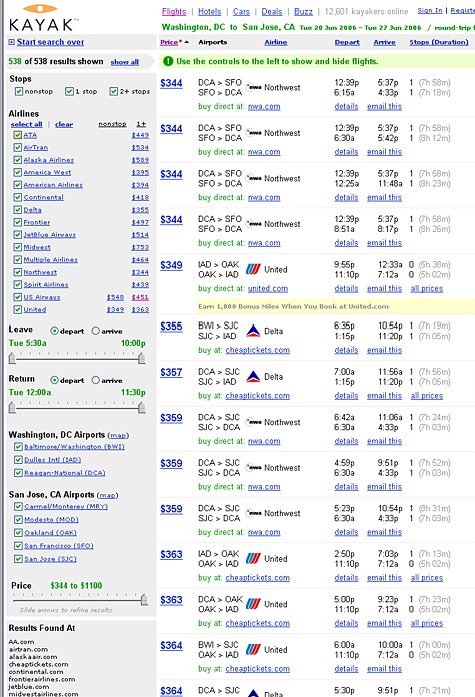
Using the side navigation, adding other airports to your search is a one-click process- the list will dynamically update based on your action. The default setting will always list the fares from lowest to highest. Want to narrow the search results by price or departure time? Just bump the slider bars to tailor the listing. Interested in showing only the flights after 7pm, do slide the departure time bar over and viola! The interface is simple, no-nonsense, and they'll link you to sites (including Orbitz) for fare purchase.
For those of us into "geek speak" you can find out how the braniacs at Kayak built the site just by visiting. They're very "open kimono" about things. For the quick version, they're using AJAX (no surprise), Java, Perl and Ruby, running on Linux. The site was developed on Mac. Click here for more information on technical construction. It doesn't end with the Kayak.com web site, either...Click here for other cool stuff they're experimenting with to enable you to use Kayak on your mobile phone, instant messenger desktop and other devices. They even have an app that ties Kayak to myspace.
Imagine what happens when Kayak functionality covers full-scale travel services, including hotels, car rental, packages, etc. It may not be long…
What does Kayak mean to the major travel sites? Well, for now, the relationship is symbiotic one. Kayak is actually augmenting the lack of search usability on other sites. In the future, however, who knows? Someone smart may purchase Kayak... or Kayak may get a huge round of VC and take over the world. Who knows...stay tuned.
In short, KUDOS to Kayak! These guys know the travel industry and they know technology. Most importantly, they know the customer and are providing the robust kind of search tool that can save consumers and small businesses time, money and effort. Wishing you every success, guys.
Experience Files: The Chop Shoppe
11:00 AM
Edit Post
 Lately, I've been spending a lot of time with my fiancee, Brent in Sioux Falls, South Dakota. Experiencing new cities is always interesting, and finding small business that offer great experience is my equivilent of treasure hunting. This week, I encoutered a little experience gem we may well see more of in the future: Readers, meet "The Chop Shoppe," a funky, fun and very male grooming lounge in West Sioux Falls.
Let me preface my overview by saying that this experimentation was spawned by my ever practical cutie pie, who, like many bachelors, has his hair cut (ala electric razor) at a local discount barber for $10. The resulting coiff certainly isn't horrifying - just very often noticably uneven - especially to the discerning female.
Thus, when we passed the "The Chop Shoppe" coming back from the mall last week, I volunteered my hubby-to-be for a little experience research. He was a great sport about it, and here's what we discovered:
The Concept:
The Chop Shoppe is an unpretentiously cool destination for male grooming. Without a doubt, the owners know their clientelle: Everything there is guy friendly, from the name (it's a lounge, not a salon!), to the garage-inspired waiting area and the private "Detailing Rooms" which offer seclusion for other services such as "Sport Fascials." While it costs a bit more to get a Choppe than a razor cut from the barber, pricing isn't too much of a stretch: Chop Shoppe hair cuts are about $20, and other products are offeered for a reasonable price, as well.
The Environment:
 Think "American Chopper" meets an upscale salon. The Chop Shoppe's lounge colors are red, black, grey and galvanized steel. A comfortable waiting room greets patrons, offering sleek leather seating and a very striking chrome and glass coffee table made out of mag wheels. Masculine details abound: Hang your coat on the gear-shift coatrack. Grab the paper from the tension mounted cable rack. Watch guy-friendly programming on one of several plasma screen televisions.
The Experience
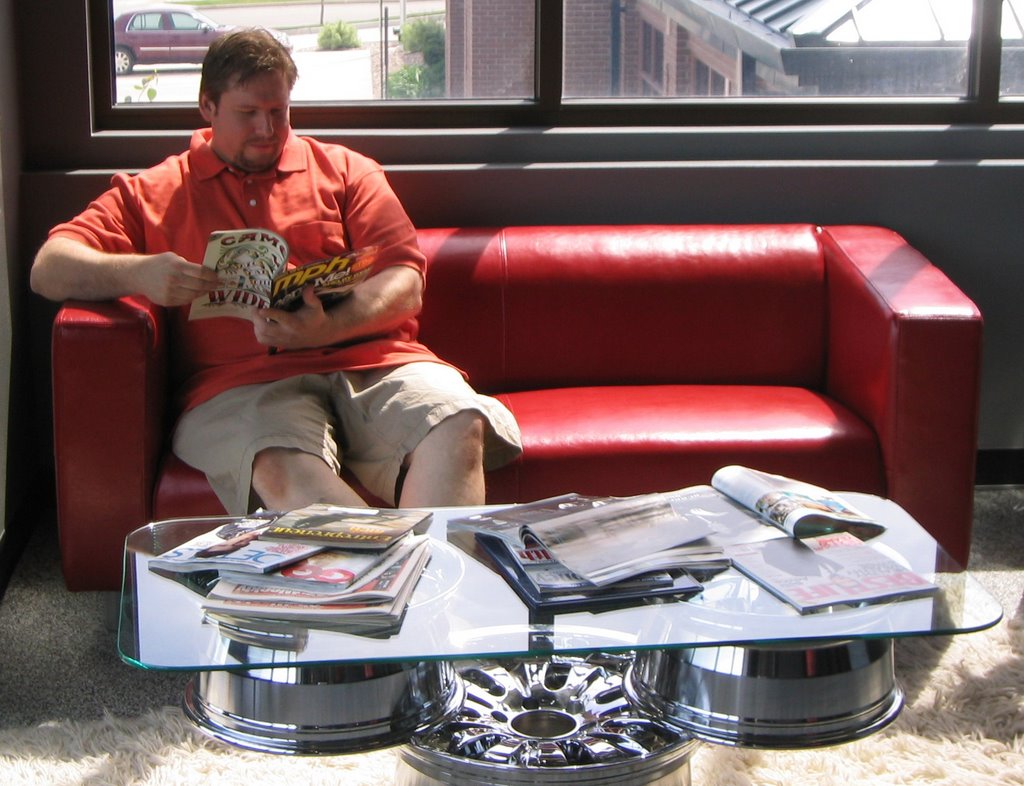 While ideally clients should be able to walk-in, the salon is booked several days in advance. It's best to make an appointment. Just check-in with the front desk and one of the lounge's very attractive staff members will invite you to relax in the waiting area. They'll also offer you a cold beverage.
  Just beyond the waiting area, there are a number of workstations; each one featuring a red Craftsman toolbox workstation and a full-length mahogany mirror. After clients consult with a stylist, they are escorted to the wash area for a luxurious shampoo and head massage. Hair cuts are skillfully executed and take about 15 minutes to complete.
  Beyond the styling stations, several private "Detailing Rooms" offer comfort and seclusion for clients seeking other male grooming services, including face and body "detailing" such as fascials, massages and body waxing. There's nothing girly about the Chop Shoppe's very popular manicures and pedicures, either. Try the patented Margarita Pedicure. They'll soak your tootsies "on the rocks" (hot stones) in a lime bath. You'll sip a frothy virgin margarita as they lull you into paradise with a complete leg and foot massage - while scrubbing, buffing and smoothing rough areas to produce sparkling, well-groomed feet.
 Aestheticians and stylitsts are not only helpful with style and service selection, they're instrumental in introducing clients to new products. The salon also offers an array of quality men's products, including shampoo, conditioners and balms, skincare and fragrance. They'll assist with product selection and offer to set up a new appointment - recommended about every four weeks.
The Business
The Chop Shoppe is the brainchild of owner, Michelle Flanagan, a veteran stylist and entrepreneur. She seems passionate about providing a comfortable, guy-friendly and inviting environment for guys who need "a little help" with personal grooming. Michelle, who can be found chatting up clients and performing services, claims that a large majority of her clients gravitate to the salon for detailing services, including waxing, manicures and pedicures. The full-service aspect of the salon makes the Chop Shoppe a best kept secret for guys who want to look their best.
Michelle's flagship store is just six months old, and doing quite well. Regular customers jamming the books. The concept and name have been painstakingly trademarked, and plans for new salons are in the works. The business concept seems quite solid: Male haircuts take less time, and men tend to require haircuts and grooming more frequently than women. The add-on value of services and product add to profitability margin. All tolled, the Chop Shoppe a fertile market for growth and expansion. The concept should be especially appealing in major metropolitan areas.
The Verdict
So, what did my gearhead guy think? He'd definitely go back. He liked his haircut (and so did I). He loved the head massage. He thought the store concept (especially the mag wheel coffee table) was fun, cool and "very guy friendly." He even bought some "welding paste" for his new "doo" (at $18). Brent said he could see himself returning regular basis, provided he wouldn't "have to wait a long time" for service. His only other criticism pertained to the "lame" car magazines offered by the lounge. He plans to provide alternative suggestions when he returns next month.
All in all, the Chop Shoppe is a great concept store with a pleasing aesthetic and a keen focus on its customer base. As with any new business, the challenge will be managing business operations, growth and expansion without undermining customer experience. We wish Michelle the best of luck and optimistically look forward to witnessing her success.
Not Your Mama's Marketing
11:41 AM
Edit Post
 Recently, I spoke to a group of marketing executives about customer experience management (CEM). After going through definitions, fundamentals and pitfalls, we started talking about what CEM really, practically means to the marketer.
 To make a critical point, I asked the group, "When was the last time your marketing plan looked like this:"
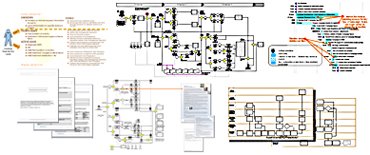
I talked about segmentation and customer persona development and how good strategies align customer segments with quantifiable goals and metrics. We touched upon the subject of customer experience mapping, which establishes and aligns multiple marketing campaigns to ensure customers don't "fall through the cracks" at any point in the journey to brand discovery. We talked about the importance of requirements documentation, project planning and business process alignment in campaign planning and execution. As we reviewed the planning process, we also addressed the importance of periodic reality-checks that ensure the segments, goals and metrics originally created align with the campaigns that are actually being developed.
There were a lot of gaping stares and the discussion triggered many desperate attempts to get copies of my slides. The group's response was extremely telling, reinforcing my assertion that many marketers are today, very desperate for tools that will allow them to better create and manage customer experience today.
Today's marketing just isn't the same as it was in the hay day of your grandmother. Heck, it 'aint your momma's marketing, either. Today, the whole face of marketing has changed, and if your organization hasn't adjusted its tack significantly, you should be concerned.
Today's leading companies recognize, support and develop the role of marketing in rallying the organization around a central vision for customer experience. Marketers today must know how to successfully interface and coordinate the activities of a broad spectrum of players, from typical agencies and service partners through to a multitude of internal players including product development, customer service and technology.
These companies recognize that marketing's ability to be successful in this role is dependent on crediblity. Marketing credibility is dependent on skills and proficiency, organization and clearly defined process. It's also critically dependent on marketing's ability to understand the needs, pressures and priorities of internal departments.
Supporting the marketing department positioned to do this requires very strong top-down coordination and leadership - that doesn't just come from the CMO or VP of Marketing level. Organizational alignment in the executive ranks must be created by C-level leadership. Now, the management dynamics required to make this happen are certainly complex. In fact, in most organizations, customer centricity is damaged by leaders that fail to coordinate departmental activity in a synergistic way. As a result, departments be come so silo-driven and task focused that the organization misses key collaborative goals for the business. And this shows to investors in the end.
I won't get too focused on the types of documents reflected above, because focusing too much on TASKS can take your eyes off of what's MOST important. If I had a dime for every client claiming they wanted to be customer centric, I'd be a rich woman. The reality is, all the planning referenced above has got to be created based on a clearly articulated vision of what prospects and customers need and want. The organization has to be rallied around - and measured against - the delivery of this vision.
We'll talk more later about some tools that can help with CEM creation and management... stay tuned.
The Vicarious Experience
10:12 AM
Edit Post
 I spoke on the subject of Customer Experience Management at the annual Marketing Profs retreat a few weeks ago. We talked alot about the concept I've been promoting for a few years called the "three word rule" and went through a list of brands that really understand the rule and how to apply it. Later on, the subject of Volvo came up, and unilaterally the one word that came up was "safety." Now, that's brand equity.
Volkswagen is now getting into the safety game with its "Safe Happens" campaign - and they're doing it with highly compelling advertising approach. Created by ad agency, Crispin & Porter, the ads feature every day people - much like yourself - experiencing car accidents. If you're paying attention, the ads drag you right into the accident in a participant's capacity.... and you'll vicariously experience the accident with the actors in the commercial. You'll also join in their relief that no one is hurt. It's very effective.
View a few of the ads by clicking here or here.
What Crispin and Porter are playing off of is the power of the vicarious experience. For example, we all know gossip and bad news are viral. What's important to remember is that customers that have a bad experience with your brand may enable others to vicariously experience the event through word-of-mouth.
I recently had a talk with a friend who likened waiting for help at the Apple Store to "waiting to be noticed by the cool kids in school." While she didn't like the experience much, she admitted she could not help but notice her desire to "be one of them." Cool by association, courtesy of the vicarious experience dynamic.
Vicarious experiences invite others to participate and engage the senses and the emotions. They motivate people to change, react, consider in a more tangible way. There's something to be learned for all of us in these examples.
Marketing Profs: Finders Keepers Review
12:26 AM
Edit Post
 I just got back - well actually I got back Sunday but am just catching up now - from speaking at the Marketing Prof's Finder's Keepers 2006 Executive Retreat I spoke for a little over an hour and a half (all of it was sanctioned time!) on the subject of customer experience. I also provided several real life examples from companies like Best Buy, Jet Blue, Medtronic, Converse and other companies.
 Now, Marketing Profs retreats are not like your average conference... First, this one was set in sunny Santa Barbara in an enchanting Bed and Breakfast with very cushy beds and deep soaking tubs. Second, the signature authors who spoke at the conference (Subject: finding prospects; keeping customers) stuck around for the entire two days to mingle with folks like you, giving free advice, listening hard and even learning a thing or two. Third, there were no vendors!!!
All tolled, there was an illuminating mix of companies at the conference, which ranged from large, high tech companies to small and mid-sized businesses. Here are some of the quotes I heard from the attendees:
"This is like the Bill Maher of Marketing Conferences. Lots of crossfire from the experts and great insight."If you missed out, I hope you'll look through the archives to find great insight from our speakers, like William Arruda (the smiling, world traveler) on Branding, Jonathan Kranz (looks like a kid - wise like an old guy) on copy writing; Jim Lenskold (way smart numbers guy with the skinny on Marketing ROI ), Jill Griffin (a southern belle with great customer loyalty chops) and many others.
"I've been to 'em all - Marketing Sherpa, DMA, you name it. I've learned more in the first four hours of this conference than all of them combined."
"Excellent. I was impressed with the high quality speakers. I'd come again next year, for sure."
It wasn't just the attendees that had a good time. We authors enjoyed meeting the Marketing Profs staff - who are (honestly) all fun, impressive, intelligent people who bring the "A" game, as well as the readers of the Marketing Profs web site. If you missed out, we hope you'll consider attending the next retreat - and I certainly hope to be there again!
Experience Engagement Ring Shopping
4:52 PM
Edit Post
 For those of you zinging me about a lack of posts, I apologize. I've been a bit distracted lately -- I got engaged last weekend and I think my head is still spinning from it all! The best way to describe the feeling is that of dizzying joy. My current state of mind, however, is a bit "spaced out."
 Over the past month... at the instruction of my fiancee, I looked for rings in an attempt to find a setting I liked. We're in the unfortunate position of being in different states which made coordination a challenge. After a few visits to some jewelers, I promised myself I'd write about the experience! Talk about an industry that could use some improvement! Let's use this as a parallel:
Imagine that you are interested in buying a car. You head into a dealership and find that the showroom is filled with a lineup of miniature models that are more economical to produce and save floor space. In the minature show room, you do get to see a 3D version of the car, but you can't sit in one because your butt won't fit in the seat. You can't drive it because some of the features aren't real. The salesman argues that the mini versions still give you the idea of what the car is like, but you don't know really how it fits you and you're left feeling dissatisfied.If car shopping were like this, how much would it motivate you to purchase?
While you're kicking the tires, you lift the hood of the car, but instead of an engine, there's either a gaping hole, a picture of an engine, or a cheap, plastic model of an engine in its place. You're asked to imagine the real thing - but you can't start it up and hear it purr yourself.
Say you're still interested in the car - but you want a different available model. In response, they show you a printed catalog with a photo. The dealership then proceeds to tell you that they'd be happy to order it for you at your expense, and if it doesn't work out, you can exchange it for another car. Uhhh. Yah.
This is the equivilant of modern-day engagement ring shopping, for me. If you think about the parallel, it's really not too far off - especially considering the cost of the investment one makes when purchasing a ring.
Mini modeling.... Let me be clear: I don't have giganto man hands or chubby fingers. I'm a size 7, which I'm told is quite average. However, after visiting more than seven stores and being forced to cram rings over my throbbing knuckle ... after removing wedged on rings with windex (which actually became my best friend) and listening to every jeweler tell me "Yeah, I don't know why they don't send us larger sizes! People complain about this alot"... I find it ludicrous that the jewelry manufacturers send most sample rings in size six!
I was interested in how the ring felt on: Was it to chunky? Would it roll? Did it sit nicely on my finger... etc. You can't tell this when it's on your pinky finger. All tolled, the size of the ring had a decided impact on my comfort level with a setting. This is especially true when one considers that changing the size of a ring can also change look of the setting entirely, and may require stone size adjustments.
While the jewelers offered to order a display ring in my size - or any other ring in their print catalogs, their assumption was that my fiancee would pay for the special order. They explained that if we were dissatisfied with the setting, we could simply exchange the ring for another one. Frankly, that seemed like a ludicrous thing to ask, and I didn't want to be exchanging a ring my love had generously gotten for me!
As for the gaping hole and picture of the engine... Trying on a setting with no diamond in it just doesn't work, folks. Even if the jewler "tweezes" a stone and holds it over the setting for you. How can you possibly know if you like a ring unless all the stones are set and you look at it from multiple angles. Sticking a CZ or two in the ring is better than nothing - although it's not quite the same to the discering eye. In the end, it would seem to me that showing the rings with very good quality diamonds would be the place to start for selling the merchandise, but I suppose I'm being an idealist.
Departing from the car parallel, one other thing that irked me about the process- and that was the almost total disconnect between the web sites of these major (and minor) jewelers and the in-store experience. It would seem intuitive that the future bride would be able to select settings and have the jeweler email an "info sheet" (or link to a web page with pricing and options) to the future groom. It would seem intuitive that the jewelers would help facilitate the transaction in some way. But nooo. Half the rings that were displayed in the store weren't on the web site -- and vice versa. Some jewelers weren't willing to give me stock numbers and manufacturer information of the rings. EGAD!
Now, I'm sure there's some economics that go into these dynamics. For example, the practice of sending smaller samples into the stores. Obviously, the smaller the ring, the less metal there is - and the bigger the diamonds look. However, the economics at play may well be costing some jewelers very good sales, today.
The national and regional jewelers we visited lost my ever diligent and extremely patient fiancee's business because they made us jump through WAY too many hurdles. They showed us too many rings, overwhelmed us with a lot of detail, made us use our imagination to the point where our heads hurt, and made us want to go away - not stay and make a choice.
In the end, the jeweler we liked best was a small, family-owned high end jeweler that had about four cases full of beautiful, carefully selected rings. Every ring was displayed with stones - all of them were lovely. The staff was laid back and extremely friendly, and they were great about outlining pricing to my fiancee in a discrete manner. They didn't preach at us, but educated us when we asked about the rings and stones. They helped make us aware of many considerations of the purchase and gave us managable options that made us want to do business with them.
In the end, I picked my setting, he picked the stones and we got a lovely ring that he put on my finger the day before easter on a bridge over the Big Sioux river. I must say, as bad as engagement ring shopping can be, there's simply NOTHING that could rob me of the joy of doing this with soon-to-be husband. After all, I got the REAL prize when I met him... and that's kind of the point of it all. :-)
I just thought the experience of the ring shopping was worth mentioning. Maybe some smart jewelers will change things up a bit and see if store conversions rise as a result! As we plan our wedding, I'm sure there will be more fun stories emerging. But heck, maybe I'll avoid some of those pitfalls and just get married on a beach somewhere! Stay tuned!
Subscribe to:
Posts (Atom)
CONNECT


LEIGH DURST

I’m Leigh Durst, a 20 year veteran in business, operations, customer strategy, ecommerce, digital & social media and marketing. Simply put, I’m a strategist that helps companies (start-up to blue chip) achieve business shift, create more compelling online and offline experiences. I also write, speak and teach about experience design and next-generation business. I’m a futurist, visionary, strategist, doer and connector with a passion for people and helping others. When I’m not on the road, you’ll find me in the San Francisco bay area, working, beaching it and hanging out with my family and dog.
NEW! FEATURED IN

The Customer Experience Edge
CO-AUTHOR OF

Age of Conversation 3 - Get yours now in hardcover, paperback and for the Kindle.
CONTRIBUTOR TO

Web Redesign: Workflow that Works
