
Showing posts with label Defining Customer Experience Management. Show all posts
Showing posts with label Defining Customer Experience Management. Show all posts
Customer Experience Management vs. User Experence (Part III)
 10:36 AM
Edit Post
10:36 AM
Edit Post
 Continuing the posts on defining Customer Experience Management (CEM)… A number of consultancies and agencies equate CEM with User Experience. In our previous article, we outlined the five key disciplines, or components, of CEM.
 User Experience, or “Usability” is focused on the interface discipline of CEM. The term is used primarily in reference to the analysis, design and/or development of human-to-technology interfaces. Some examples of this include creating, refining and managing:
User Experience is an important part of CEM, but like Experiential Marketing, it’s a part of a much larger whole. User Experience architects center their focus creating functional, intuitive interfaces (online or systems applications and technological devices) that enable customer interaction and transaction. CEM practitioners focus on the comprehensive interaction of customers in both online and offline channels.
Contrary to popular belief, User Experience is both an art and a science that requires a complex array of skills. Individuals who “do” usability can’t possibly embody all skills, although if you find a rare individual that does, you should pay them a mint! Dave Rogers of gotomedia recently wrote an excellent article about this in the gotoreport. Many of us will resonate with Dave’s frustration. To underscore Dave's assertions, here’s just a sampling of the functional roles that might found on a more complex user experience project:
While it might be natural for any individual to assume 2-5 of the roles described above, many of you feel the pain of being asked to manage many – or all – of the roles outlined above yourself, or within a limited internal team. My advice to you: Keep educating your company about the nature of user experience with articles like this one. Be sure to tangibly demonstrate the results and forge ahead! Fortunately (job security) and unfortunately (you may have no-life!), this isn't likely to get much easier. The demand for user experience professionals is likely to increase. Here's why:
1. Electronic channels are being integrated into traditional channels with increased frequency – and usability professionals are instrumental in helping us become more proficient and creative about how we use them. From increased integration of coupons, kiosks, wireless promotion… we’ll see more folks with traditional usability expertise being drawn into the broader CEM discussions. For example, the kiosk design team may be included in discussions on how to optimize kiosk use with in-store placement and visual positioning.As consumers continue to adopt new technology, and utilize technologically driven channels for interaction and transaction, user experience (human-to-technology) competency will continue to be a critical factor in driving effective customer experience. This is especially true as technology continues to evolve and devices begin to mature and converge, generating entirely new products and services for consumers.
2. Companies are beginning to apply more concentration on creating a more “seamless” customer experience across channels. Collectively this will force an increased demand for individuals with expertise in mapping out comprehensive experiences and designing interactions. This is a much-needed skill that must be applied within, and across traditional channels in order to effectively track and streamline the larger customer experience.
3. User experience resources are accustomed to a customer centric design bias (vs. business centric bias). They are therefore more familiar with behavioral customer dynamics – in addition to channel dynamics, and greatly suited to helping design interactions from a customer-centric perspective.
4. A growing awareness within companies for the need for user experience staff will drive increased hiring capability. This has already become visible in the job market today, as increasing number of user experience job descriptions present themselves. The ongoing challenge will be getting the position descriptions correct. As Dave points out in his article, most companies expect way too much from single resources.
Usability, as a part of CEM, will work to ensure technologically driven customer interfaces meet customer need, while additional attention will be focused by CEM practitioners on streamlining, synchronizing and improving holistic customer experiences across online and offline channels.
 Labels:

Customer Experience Management
vs.Experiential Marketing (Part II)
6:56 PM
Edit Post
 Continuing the dialog on defining Customer Experience Management (CEM)...
Many individuals equate CEM with Experiential Marketing. However, the term "experiential marketing" has become perceptually aligned with marketing execution in recent years. This is because it largely focuses on developing highly visible, stimulating, interactive and sensory-engaging environments in which products and services are showcased. As such, experiential marketing is an important component of CEM, but it isn’t the “whole enchilada” (Ole').
The environments experiential marketers focus on are diverse. You'll often find a large emphasis on shaping the "walk-in" experience of brick and mortar environments. This is done with the goal of creating more positive, intuitive, memorable, engaging and pleasing environments which better engage, entertain and support customers. Some examples of this include:
Museums and galleries. Because they focus on creating a sensory experience, museums and galleries like the Guggenheim, the Smithsonian, and the San Francisco MOMA have always had a high level of focus on how to create the proper experiential environment for visitors and have therefore been proactive in the application of new technology to enhance experience and both preserve works of art for future visitors.Experiential Marketing carries with it as strong association with event-driven marketing. In the past, this has been primarily associated with trade shows, technology showcases and industry conferences. Howver, today, event-driven marketing tactics are becoming increasingly popular in non-traditional venues, such as:
Stores. Retail outlets that sell goods are placing increasing emphasis on developing more experiential environments. Visit REI and spend some time on the climbing walls available for public use. Walk in to a Build-A-Bear Workshop and create a custom toy, complete with a voice chip, for a friend or loved one. Other, more obvious experiential retail environments include Apple Stores, Niketown, the American Girl stores. More subtle examples include Sephora, Anthropologie, Origins and Libby Loo.
Restaurants. It's not just about food anymore. Restaurants are getting into the game, as well. Almost all of us are familiar with the time-tested experience offered by Chuck E Cheese. Some more modern examples of the Rainforest Cafe and Planet Hollywood. You don't have to be big to be experiential. My five year old niece's favorite restaurant is Sushi Takahashi, because of the circular sushi bar and the circling model train which delivers your order. My brother and I like it because the sushi is great, and cheap.
Non-traditional Environments, and is alive and well in several popular grocery chains, such as Wegman’s and Whole Foods. We’re also seeing forays into experiential marketing within the financial services (e.g. ING Cafés), health care (e.g. Minute Clinic) and other industries.
Microsoft's somewhat recent and highly successful multi-venue Tablet PC promotional event. Born out of a partnership between Microsoft and the Jack Morton agency the event resulted in 125,000 product demonstrations in high-traffic airport terminals in major hub airports across the country.As marketing becomes increasingly experiential in nature, the lines of demarcation between event-driven marketing and other promotions are becoming increasingly cloudy. For example:
Another example was featured recently in a recent CMO Magazine article on B2B experiential marketing. The article highlights IBM’s Merlin Center, an experiential environment created to effectively demonstrate the future of high technology banking to bank executives. The experience starts in a living-room like environment featuring warm biscotti and coffee. It gradually transitions into an experience that has been described as a "virtual themepark for banking executives."
Adrants recently gave a hat-tip to Lexus, which drew attention for strategically placed experiential displays positioned in Times Square and a several other key US locations. The displays, placed at sidewalk level in shop windows, featured a “holographic” animation of the IS in motion - zooming, spinning, turning and driving within the store window space. Interactive kiosks allowed visitors to control the display features, such as the color of the car. The displays drew substantial attention and shut down street corners successfully as onlookers jammed busy sidewalks.Experiential marketing also applies heavily to the online world, where the constant drive to innovate and improve customer experience and dynamic qualities are ever present. Product searching, personal recommendations, reviews, rating tools, list sorting/filtering and wish lists become common features of top retail and/or promotional sites.
Experiential marketing promotions were also featured in recent episodes of the hit TV show “The Apprentice.” In several shows, the teams were assigned the task of creating innovative marketing campaigns for Dick’s Sporting Goods and Tide, as well as innovative product displays for Best Buy’s video release of Star Wars III.
Today, companies strive to press the envelope of traditional interactivity further, to improve site and application usability. In addition to utilizing rich media, flash, DHTML, Java and Ajax to bring new, more engaging and effective sites to bear, an increasing number of companies are making good use of other techniques. Viral microsites, gaming, downloads and eCards are being used to help encourage site interaction and visitation. Blogs and podcasting are adding a whole new dimension to site interactivity and content. Product customization, enhanced products and services are an emerging trend.
Nike allows customers to create and customize their own athletic gear at NikeID.com.It occurs to me that I'm preachin' to the choir now. Many of you are highly familiar of the tenants of experiential marketing - and I haven't even addressed how the really great experiential marketers pay so much detail to interaction, they work to refine person-to-person interaction within these environments (e.g. the W Hotel), or engineer product displays to boost the efficacy of merchandising - among other things. However, in the interest of length, let's move on to discuss how experiential marketing relates to CEM.
Online stores like Lands End and The Gap’s "Watch Me Change" viral site allow customers to create customized avatars, based on the peronal height, weight and body style attributes. The avatars can “try on” selected clothing for the customer and allow style and fit comparisons. In the case of The Gap, you can also get them to perform an entertaining strip tease for you, and pass it along to a friend.
In addition to hosting an online car configurator, Mini Cooper has an interactive site somewhere (sorry, couldn't FIND the flash application while writing this article!) showcasing a wide number of customized roof wraps customers can puchase for their cars. The artwork includes the british flag, sci-fi scenes, the Mona Lisa and much more.
The Converse Gallery offers independent film makers the ability to submit 20 second short films, dedicated to the Converse brand. Many of the high quality "shorts" are now serving as part of Converse's national advertising campaign.
Unfortunately, many executives are being seduced by the flashier side of experiential marketing and can mistake it for CEM in its pure form. A cadre of agencies now purport to have expertise in experiential marketing and readily capitalize on opportunities presented by market shifts, retail expansion and new technologies. Typically, however, such agencies execute work within a relatively narrow scope - compared to full-blown CEM project work.
Confusion between experiential marketing and CEM often forces attention away from the real value and tangible benefits of CEM initiatives. The differentiation the two can be succinctly described as follows:
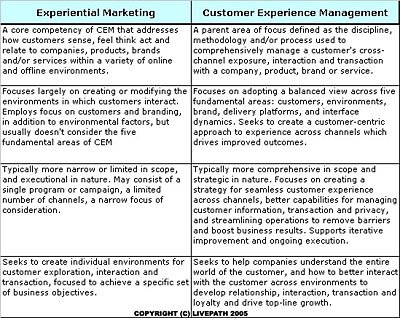
In closing, I'm not a huge fan of buzz words or hype. It's a simple truth that everything we do as marketers is experiential at some level - from the brand assets we create, to the packaging, collateral, IVR scripts we write, or the stores and web sites we manage. We have complete control over how "experiential", engaging or stimulating we are, and how perfunctory the interactions we design become. At times, perfunctory is better... and at other times, engaging, stimulating and sensory-involving is better.
Whatever the case, the companies that are faithful in the "little things" will be granted much more. Each little customer interaction is a highly valuable part of a larger set of interactions. The outcomes of customer interactions shape brand perception. Customer interactions should therefore be strategically designed and executed to work together to collectively lead the customer in an appropriate (and positive) direction that compliments personal goals and business objectives. This is the core focus of CEM.
The true leaders in customer experience understand these principles. They are adamant about creating experiences within channels - and across channels - that are intuitive, consistent, engaging, cohesive, safe, relevant, seamless, memorable and satisfying for customers. Experience leaders never get caught up in flash over substance, but leverage experiential marketing as an effective tool to gain exposure, attention and customer mindshare. They focus a great deal of energy on becoming increasingly proficient in the principles of Customer Experience Management.
Defining Customer Experience Management (Part I)
2:45 PM
Edit Post
 A growing number of books and articles are actively promoting the concept of Customer Experience Management (CEM). Popular leaders include Bernd Schmitt, author of “Customer Experience Management” and "Experiential Marketing". Joseph Pine and James Gilmore, co-authors of the book, “The Experience Economy” have also gained a great deal of exposure. You may have read “Managing the Customer Experience” by Shaun Smith, or “Customers.com” by Patricia Seybold. You may also have seen articles about and Harvard Professor, Gerald Zaltman, author of the book How Customers Think. There are also a growing number of agencies and consultancies claiming expertise in CEM – all with varying degrees of involvement and expertise in the arena.
While there’s a clear reason to become a staunch supporter of CEM, there’s a great deal of confusion over what it really is. As more individuals get on board the CEM band wagon and build services in the arena, confusion seems to be increasing. It’s time to demystify the hype:
Defining CEM
While no individual really “owns” the term “Customer Experience Management,” it is often attributed to Bernd Schmitt who, in 2003, defined CEM as “the process of strategically managing a customer's entire experience with a product or company." Building further on Schmitt’s definition:
The term "Customer Experience Management" represents the discipline, methodology and/or process used to comprehensively manage a customer's cross-channel exposure, interaction and transaction with a company, product, brand or service.
Five Functional Areas of CEM
When we look at the nature of Customer Experience Management, there are essentially five key areas that CEM practitioners or “Experience Architects” examine. While these are broken down consultants in slightly different manners, based on individual methodologies, they can be described, at a high level, as follows:
1. The Customer. CEM analysis focuses on developing a multidimensional understanding of customers. This understanding includes cultural, sociological, behavioral and demographic analysis, and culimates in a detailed ability to articulate the needs, wants, desires, expectations, conditions, context and intentions of various customer groups. This understanding informs audience segmentation and guides the prioritization of key segments. Customer analysis is proactively benchmarked against a company’s capability to meet customer needs - both in a present and future state capacity. Customer understanding therefore serves as the primary driver in shaping the business approach, aligning strategy and investment.
2. The Environment. Examining the “landscape for brand discovery” is an essential tenant of CEM. This landscape is comprised largely of market conditions, competitive factors, channel use (and channel/cross-channel dynamics), the process for purchasing (steps to buying), the “real” purchasing environment (store, phone, web, etc.) and the service environment. Leveraging this knowledge against customer analysis, CEM strategists work with companies to create integrated plans, which “order the paths” customers commonly follow in the purchasing process. These multi-path strategies work to ensure customers have an intuitive, pleasing experience at every step in the journey to brand discovery. As a part of Environmental Analysis, strategists also focus on applying experience innovation to customer environments, which remove barriers that confuse, inhibit, discourage or de-motivate customers, and create a more engaging, efficient, pleasing, personable or memorable environment within which to interact.
3. The Brand. From a tactical perspective, this analysis involves the development of visual identity, assets, tag-lines, communications, logos and other brand assets that help shape perception and define the brand in the marketplace. From a strategic perspective, however, this analysis focuses on innovation and differentiation. This includes the consistent and iterative evaluation, planning and refinement of product or service features, functionality, pricing, options, attributes, benefits and positioning of the company, service or product.
4. The Platform. A company’s operational infrastructure is the platform on which customer experience is delivered. As a result, operational efficiency has a direct impact on customer experience. As companies move from an “inside out” focus (on internal operational constraints such as production, capacity, etc.) to an “outside in” focus (on customer-centric delivery), operational analysis is essential. This includes comprehensive evaluation and improvement of people, process, policies, technology and systems that facilitate, track and measure customer interaction and transaction. CEM Platform analysis may include technology implementation, workforce evaluation, fulfillment and logistics analysis, process improvement, systems analysis, policy reviews and a myriad of other tasks. The goals of platform analysis include streamlining operations, increasing time to market, removing barriers to customer satisfaction, lowering costs and improving the overall customer experience by creating operational excellence.
5. The Interface. This area of CEM analysis focuses on the interaction between consumers and the brand, from a human-to-technology; human-to-human; and human-to-environment perspective. Simply defined, this area focuses on refining and optimizing the customer interaction within any channel to produce desired and pleasing outcomes. At a tangible level, CEM Interface analysis may center on improving the usability of electronic applications or products (e.g. a web site, a TIVO interface; or the buttons and information flow on a cell phone). However, it also concentrates on optimizing the interfaces within other channels, such as brick-and-mortar outlets. CEM strategists focus on how customers interact within, and across channels, often examining the end-to-end shopping and service delivery process. This may include task-based analysis of various interactions and transactions, such as a customer's discovery, browse, shop, purchase and post-sale experience. CEM practitioners focus on improving the quality and efficacy of customer dialog. This may include conducting analysis of the call-center or voice-response systems, as well as optimizng the approaches of sales or other customer-facing staff.
It’s relatively easy to find individuals who can work within one or two of the areas above. What separates CEM practitioners from the pack an adamant dedication to examine all five functional areas with companies to develop truly cohesive strategies and plans that result in tangibly improved customer experiences and better business outcomes.
It's easy to confuse CEM with CRM, Usability and "Experiential Marketing" ... we'll talk more in future posts about how it all fits together.
Resources for this article include materials produced by Bernd Schmitt; Joseph Pine/James Gilmore and other authors referenced in the initial paragraphs of this book.
Subscribe to:
Posts (Atom)
CONNECT


LEIGH DURST

I’m Leigh Durst, a 20 year veteran in business, operations, customer strategy, ecommerce, digital & social media and marketing. Simply put, I’m a strategist that helps companies (start-up to blue chip) achieve business shift, create more compelling online and offline experiences. I also write, speak and teach about experience design and next-generation business. I’m a futurist, visionary, strategist, doer and connector with a passion for people and helping others. When I’m not on the road, you’ll find me in the San Francisco bay area, working, beaching it and hanging out with my family and dog.
NEW! FEATURED IN

The Customer Experience Edge
CO-AUTHOR OF

Age of Conversation 3 - Get yours now in hardcover, paperback and for the Kindle.
CONTRIBUTOR TO

Web Redesign: Workflow that Works
